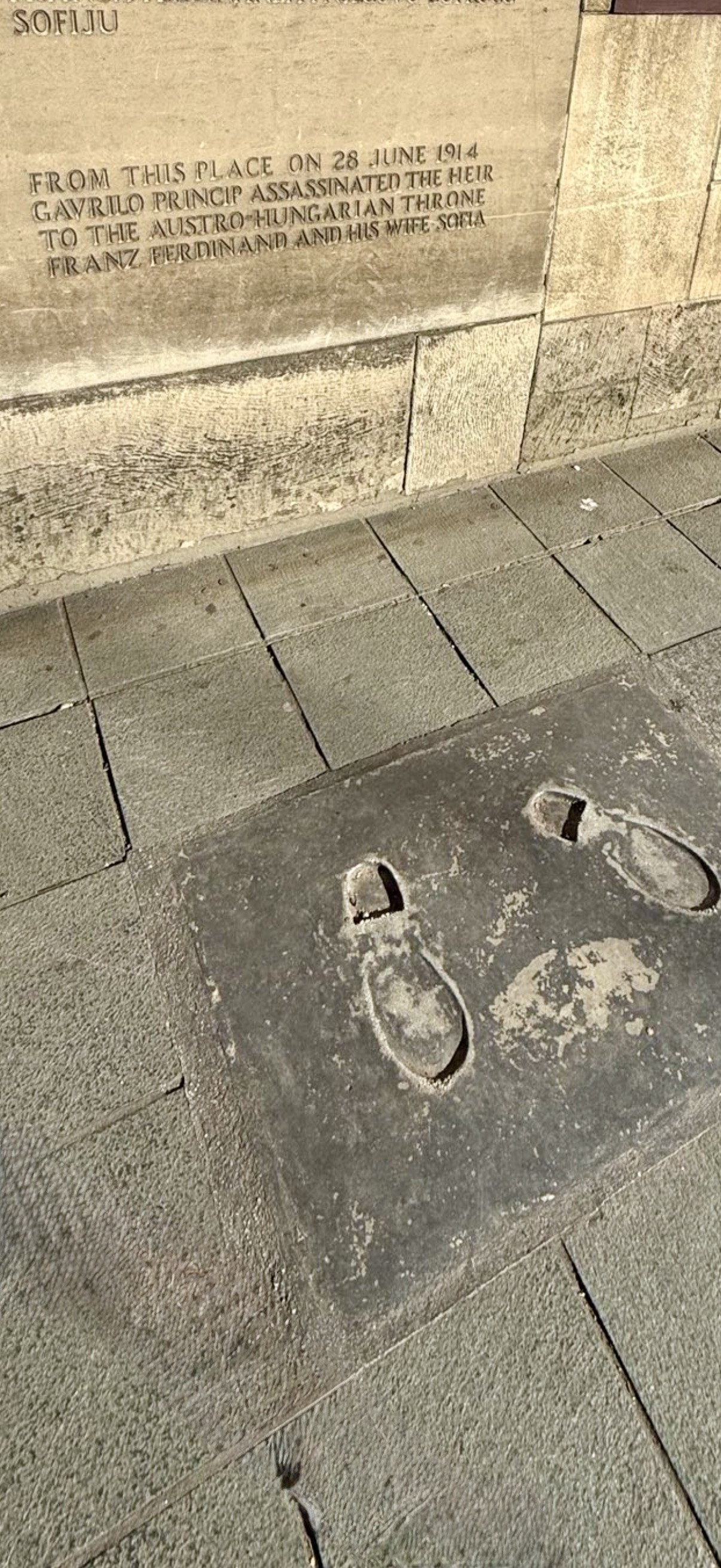
Returning to Sarajevo…

27 Oct

Good Morning, Sarajevo: 

It has been a while. Last moment I spent any time here, the Balkans were spiraling into a brutal, murderous ‘uncivil war’ — one that returned the horror of ethnic cleansing to Europe after half a century of European postwar peace.

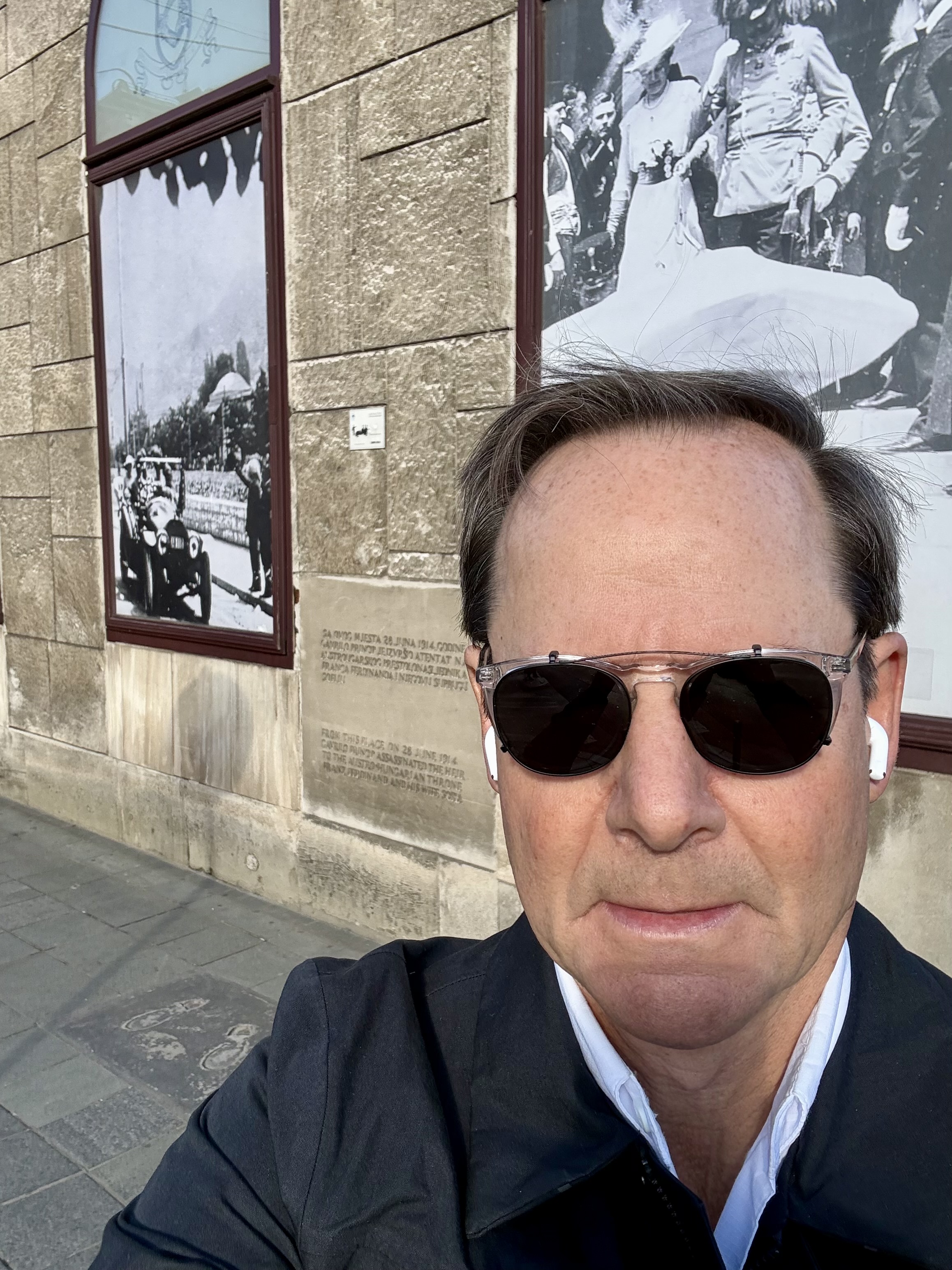
Then, it would have been unthinkable to linger for selfies’ on this spot in Sarajevo Bosnia where the assassination of the Austro-Hungarian Empire’s Archiduke Ferdinand catapulted the world into a First World War. I have no ‘before/after’ ‘cellphie’ to compare from my reporting days here in the 1990s. No ‘cellphies’ because there were no cellphones. What there WAS in Sarajevo was….snipers in high spots and artillery in the hills that surround this beautiful and historic mountain city. In the mid-1990s, no one was lingering in downtown Sarajevo to point a Leica in their own face.

But it’s today and let the record show: A peaceful Sarajevo that is safe for selfies in 2025. And that is progress.

Although the Balkans remains restive (where isn’t)? In fact the situation here is nothing like what it was in the early 1990s. Incomparably better.

I am here this time for a meaningful and important convening of Balkan and global journalists about technology and AI and misinformation and disinformation, convened through our Center for News, Technology and Innovation (www.cnti.org) and the great folks at The Thomson Foundation. That alone is a sign of progress. 

And it is my great good fortune to be able to return to such cities as Sarajevo that were important in my reporting life and which remain important in civil society and to the world as a whole. And to see them at peace in a way unthinkable a few decades ago. That gives me hope. And thank you @normpearlstine and @paulsteiger who sent me here in the first place, and provided me the invaluable gift of this perspective. 

Screenshot

A Hint of Freedom in Lebanon

19 Sep

BEIRUT, Lebanon — A hint of freedom? That’s the headline from my visit this week to Beirut, the capital of Lebanon, and a day spent traveling the country’s fabled Bekaa Valley. 

I participated as a technologist and media person in the festival ‘Un Vent de Liberté’ an extraordinary convening marking the centenary of  L’Orient-Le Jour, the leading French-language news organization in the country. 

Our contribution, highlighting recent research from Center for News, Technology & Innovation – CNTI to the gathering, which also featured a conversation with Lebanese Prime Minister Nawaf Salam and a fireside chat by former French president Francois Hollande, focused on Artificial Intelligence and its impact on society in general and the Mideast in particular. 

More on that below.

But first, a word about this ‘hint of optimism’ — a key takeaway from many conversations with political and government officials as well as diplomats, NGO leaders and journalists. Good ones.

Relative stability in the Lebanese coalition government combined with progress in disarming the Iranian-backed Hezbollah military is leading to sentiment that if things are not yet substantially improved, at least they have stopped worsening.

While anyone familiar with global affairs and the Mideast particularly would be wise to be cautious, the current feeling of tentative hope is an important change and noteworthy step forward.

Prime Minister Salam said as much in the brightly chandeliered and exceptionally air-conditioned reception room of Grand Sérail, the Ottoman Palace that is his headquarters. Lebanon’s still relatively new premier told us he quit heading The International Court of Justice in The Hague seven months ago to return to his native Lebanon to lead its multi-faith, multi-cultural government because of a ‘window of opportunity (to achieve) reforms’ to assure Lebanon’s success. Former French Premier Hollande joked that he came to Beirut to learn ‘how to operate in a successful governing coalition’, a teasing reference to France’s choppy political waters.

While the visit was ‘extraordinary’ — a word so often used it almost always is a trite exaggeration —  here, I’d argue, it is not.

And it would be wonderful if it could simply become ‘ordinary’ to travel to Lebanon and its countryside, especially to the strikingly beautiful Bekaa (whose dry brown hills and flat plain recall California’s Central Valley) and the remarkable temples of antiquity at Baalbek, larger physically and in some ways better preserved than Athens’ Parthenon. 

I won’t diminish potential riskiness; beyond the checkpoints manned by the Lebanese army, Hezbollah remains a visible and potent political and civic force particularly in the Bekaa. Obviously there is the overlay of the Gaza conflict. During the days preceding and following our visit, Israeli warplanes bombed suspected Hezbollah strongholds on the foothills that run alongside the Bekaa, as well as Nabatiyah in the Shouf Mountains to the south.

Dangers, both perceived and genuine, caused the festival to be postponed several times in the past years. This year actually marks the news organization’s 102nd year, but let’s not quibble: Any news organization is celebrating over a century longevity is a remarkable achievement, and a reflection of the strength of CEO Nayla De Freige and team. Still, nothing and no one presented any risk to our small group, who were among just a handful of visitors we saw in Bekaa.

Back to the AI panel, because developments in global technology are widely recognized at the center of this fragile optimism. While panel leader French newsman and L’OlJ board director Ludovic Blecher cited widespread agreement that enthusiasm surrounding AI and its impact is hyped, there was also agreement – as well as many questions — about the profound impact on economics, business and civic society. 

Fellow panelist, American University of Beirut Computer Science Professor Fatima Abu Salem made the point that the absence of verifiable and trustworthy ‘big data’ in the region is an important factor that can diminish and imperil the value of AI and its large language models in the Lebanon and more widely in the global south.

Artificial Intelligence, she said, thus cannot be any sort of panacea for nations that need to make progress on fundamental building blocks of inequality access to technology and resources. This, she added (and I agree) is an under appreciated problem. Moreover, when the core learning data is suspect, the output will also be suspect.

Innovation expert Kristen Davis spoke of her experience as de-mining NGO APOPO  begins to explore AI as an accelerant to its ‘hero-rat’ mine-detecting rodents. Kristen made the point that AI has the prospect of improving lives in the region, if it is deployed intentionally and used wisely.

On behalf of CNTI, I presented our most recent #Briefing:AI Literacy and Communication which focuses on the intersection of AI and Journalism. To me, it seems inevitable that AI – regardless of its hazards – will offer opportunities both for cost reduction and revenue growth. It is a genie that will be impossible to return to a ‘bottle.’

There is much more to say, and I will find a way to say it. But I left Beirut and Lebanon with a greater appreciation of the strides made thus far and the work ahead to make the ‘hint of freedom’ a firmer reality.

A Valedictory Column in The Miami Herald

17 Mar

You will decide the future of local news

BY CRAIG FORMAN MCCLATCHYAUGUST 30, 2020 07:00 AM

  • EDITOR’S NOTE: McClatchy, which owns this newspaper, will emerge from bankruptcy, likely on Sept. 4. It will be owned by Chatham Asset Management. The following column represents a farewell to readers from the departing McClatchy CEO.

“Your business model is literally throwing yesterday’s news at people’s houses. How long did you really think that would last?’’

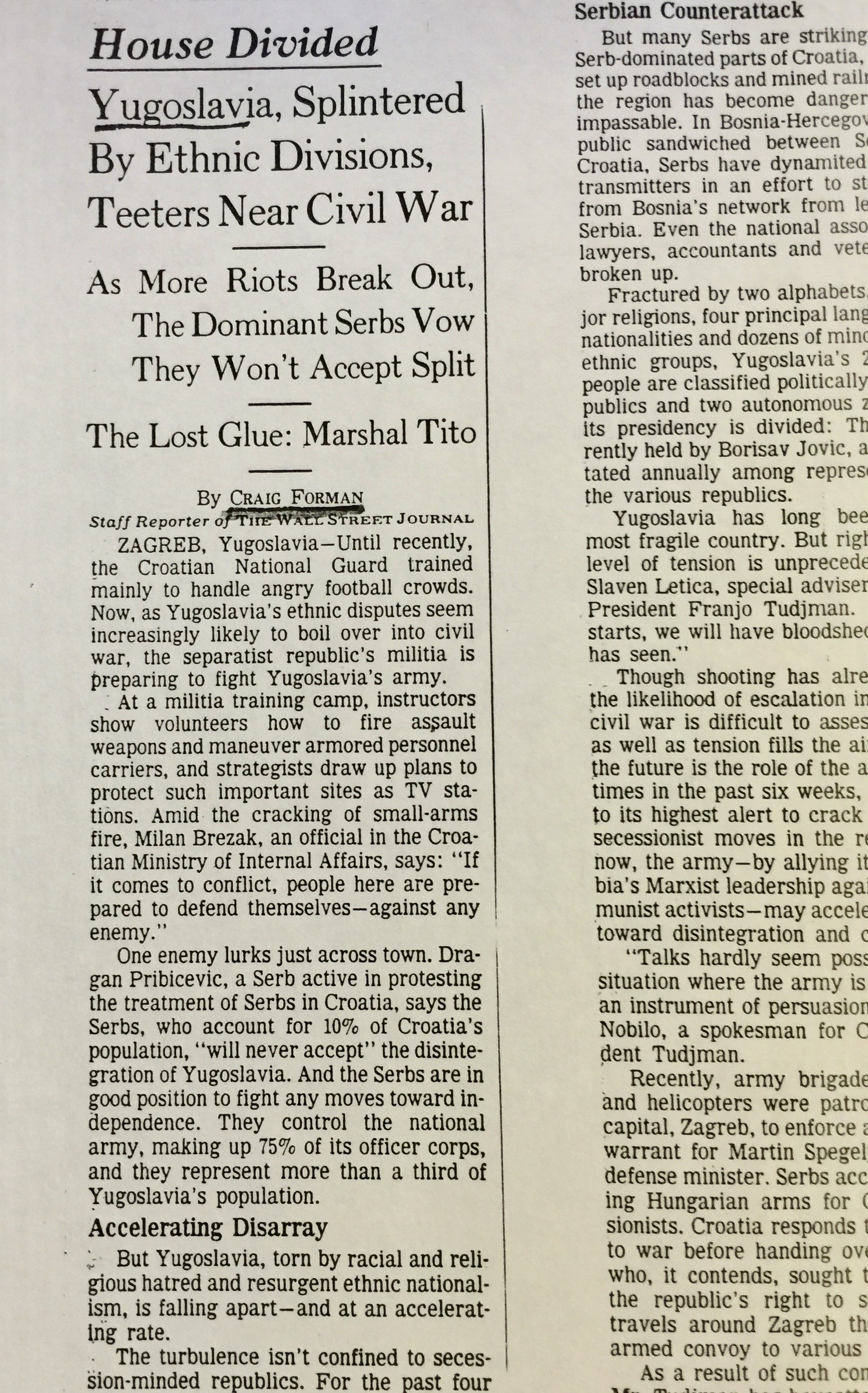
That provocative question wasn’t on many people’s minds some years ago, when I left newspapering for the first time. That era marked the golden-age peak for American newspapers and had provided me a once-in-a-generation opportunity to report the world as a Pulitzer-finalist foreign correspondent and bureau chief at The Wall Street Journal.

And more than a few colleagues thought I was crazy when I left a promising career in journalism for a speculative Silicon Valley startup. This was the era before the iPhone, Facebook, and TikTok, and the internet was so new colleagues thought a “search engine” was a newfangled kind of executive recruiting for the digital age.

Now, as I leave newspapering for a second time to return again to Silicon Valley, I hand over the helm of McClatchy to Chatham Asset Management, which will become the new owner. This is the first change in the McClatchy family’s ownership in 163 years.

McClatchy’s emergence from court-supervised bankruptcy reorganization provides a great opportunity, and a unique moment: McClatchy will have a stronger balance sheet and capital structure and put the heavy debt load and pension burdens of previous decades behind.

What will the future hold? I’m reminded of a parable the novelist Toni Morrison shared in her acceptance speech for her Nobel Prize for Literature. It was about a young child who thought he could outsmart an old, blind woman known for her wisdom. He held a small bird in his hands and asked the old woman if the bird was dead, or alive.

I’ll tell you the end of the parable in a few paragraphs.

No question, as McClatchy emerges, the landscape of local news looks vastly different, and in some ways even more daunting, than the dawn of the consumer internet revolution almost 25 years ago.

The challenges facing local news pose tremendous questions for our communities and our way of life. Digitalization has created headwinds for the print advertising revenue that once sustained much larger newsrooms. Newspaper revenue never recovered from the 2006 recession, and American newspaper revenues are today $35 billion lower annually — a decline accelerated by this year’s Covid-19 pandemic. That decrease has led to waves of job reductions, and the closure of more than 2,000 local newspapers in the United States.

We must overcome these challenges. Data show that when the local newspaper closes, communities suffer — there is increased polarization and less political engagement, and even borrowing costs soar for local governments in the absence of independent-press oversight.

Moreover, we cannot ignore the persistent attacks on the press. While many surveys show that the American people still put considerable trust in their local sources of news, the vilification of the press has made life worse — and headwinds stronger — for all, with no discernible benefit to anyone.

As America’s second-largest local news company, McClatchy is doing its part to save local news. For starters, this enterprise is blazing a trail for sustainable local news and in the last three years McClatchy has become profoundly digital, led by world-class digital-first leaders organized the way a Silicon Valley company is organized — by function, not geography.

The business is now roughly 50% subscriber revenue—many thanks to all of you who subscribe to digital, print or both — and almost 50% digital revenue vs print. This is a far better and self-sustaining mix for an era where the revenue growth is in digital.

Your trust in us at McClatchy and your financial support are proving the value of local news. We are gratified that nearly 700,000 of you are paid digital customers. And this is my moment to thank 2,800 resilient and tireless colleagues who are among the strongest single team in local news, well-prepared for the challenges ahead alongside my successor as CEO Tony Hunter and the new owners to whom I wish the best.

Nonetheless, the headwinds remain. While McClatchy emerges from reorganization stronger, local news still faces big challenges to its business model and to returning to growth in revenue and in profitability.

So what are the solutions for a healthier local news environment? There isn’t a simple prescription to build a sustainable future for local news. But here are some thoughts.

McClatchy’s transformation shows that by focusing on fearless journalism, relentless customer engagement, standout products and a sensible focus on sustainable operating cash flow, publishers can accelerate digital success and build a sustainable local news business.

Reporting in service of the public — the sort that produces award-winning investigation of Kansas statehouse secrecy and the Miami Herald’s impactful work on sex predator Jeffrey Epstein — drives successful engagement, subscription and audience economics.

This sort of journalism requires persistence and dedication as well as resources and scale. This work also reflects the steadfast commitment of a proprietor unafraid to take on tough stories, and unwilling to compromise integrity. This is a moment for me to thank the McClatchy family, led by Chairman Kevin McClatchy and our fellow board members, for their unwavering commitment to independent local news in the public interest.

That is why we counter know-it-alls who say “just let the large news chains die.” While it will take a blended new innovative model to reach success, there isn’t a startup in local news that has the scale or resources to have achieved this level of investigative coverage.

McClatchy has never lost sight of its mission of independent journalism in the public interest, evidenced by our 54 Pulitzer Prizes. While we are a smaller organization, we continue to “punch above our weight.” Keeping the product strong and focused — essential to its community — is at the core of success.

We are proud, too, on the days we launch The Compass Experiment for new communities, which in partnership with Google has returned vibrant local news to such news deserts as Youngstown, Ohio and Longmont, Colorado. We also pioneered easy ways for readers to add digital subscriptions via Subscribe with Google, Local News on Apple News Plus and on the Facebook News Tab.

More users reach our renowned brands through means other than the printed newspaper than ever before. And though our hundreds of thousands of paid digital customers sounds like a lot, it remains nowhere near big enough given the total addressable market. Successful local news requires a relentless focus on product quality, innovation and service delivery.

And the business model? This is why we worked so hard to stabilize operating cash flow. Digital is about half our business in the 30 communities around America that together make McClatchy — a better balance than the 80%-plus reliance on print advertising in some markets that we faced in 2017. But the print side of the business remains challenged as more and more of you seek out news and information on your mobile devices.

Facing this truth, managing cost becomes important. That is why we worked so hard to cut costs (more than $300 million) and reduce the debt on this business. And have been able to do this, paying off almost $4 billion in debt and funding the pension to $1.4 billion, because McClatchy has produced strong cash flow. Leverage is a burden — through interest payments and debt service — that slows the ability to invest in news, product and technology.

Radical thinking is needed in local news. I believe we need a multidisciplinary approach to understanding and developing solutions.

There are digital start-ups taking a new approach along with promising experiments with not-for-profit business models in Philadelphia and in Salt Lake City. The Knight Foundation has produced a useful guide on operating as not-for-profits. In addition, partnerships to add community-funded resources, such as the Report For America program, are a helpful and important start.

Also required is both an understanding of the capital markets and capital structures of legacy “chains” and startups, whose business models themselves are speculative and even fragile, as well as the legal framework in which local news operates. Equally critical is understanding Silicon Valley and the major tech social media, search and other platforms that now control so much of how people access as well as the regulatory framework that determines revenues between the platforms and news publishers.

But most important of all is you. Your support, by subscribing, by engaging, by sharing, by objecting, by being citizens interested in the news and information in your communities, is the key factor that will determine the future of local news. Media companies will have a lot to say about the future of media. But so too will neighbors who pursue knowledge, seek justice and serve others.

I am certain strong, sustainable local news is possible. It will require a coalition of the willing. And it is necessary for our democracy.

So now, back to Toni Morrison and the parable of the small bird and the little boy.

The little boy challenged the old, blind woman and asked: “Is this little bird dead or alive?” His plan was, if she said, “It’s alive,” he would squeeze the life out of the bird. If she said it was dead, he would let the bird fly away. Either way, he would be right.

“Old lady, is this bird dead or alive?” She stood silently. The boy started to laugh.

Then she spoke. “It is in your hands.”

McClatchy and other local news companies will continue to create a space where people can debate and disagree but still “dwell together in unity.” We will continue to serve our communities, and you, with local news and information you can trust. We have for the past 60,000 days. And we intend to for the next 60,000.

But the future of local news? The answer is truly “in your hands.”

Craig Forman is president and chief executive of the McClatchy Co. He is a technology executive and investor and is returning to his role as West Coast general partner of Next News Ventures based in San Francisco.

To see this column in the original, click here: https://www.miamiherald.com/article245264070.html
#CanDo: The Nation That Can Do Anything….

5 May

I am not certain why I appreciate the story of the Marine Corp.’s rebuilding California’s Catalina Island Airport In The Sky as much as I do.

There is a lot to it: Aviation from the barnstorming days. An impossible task for anyone other than the US Defense Department. Fighting SeaBees engineering and Marines. A gift to a grateful nation and a Pacific Island (albeit within view of Los Angeles).

Perhaps it is simply a reminder of a time when impossible tasks took only a few days to complete at a time in our nation when it seems the most trivial task can seem daunting and impossible.

Anyway: here’s the story:

There was an aging airport at the top of Catalina Island off the coast of California. It was costing a fortune for the state of California to maintain. It is a vital lifeline for the island — firefighting base, health care rescues, etc.

Enter the Marines. Seven decades ago, while not routine, Marines and their naval engineering brethren the SeaBees would storm ashore Pacific Islands during WWII and build airbases in the jungle in just a few days. Combat bulldozers and earthmovers, Mattson mats, living in jungle tents.

They can still do that. And they did. It took a little longer than a week,as this story points out:

https://www.military.com/daily-news/2019/05/05/marines-navy-rebuild-deteriorating-airport-sky.html

And here are some mockups of what the airfield looks like now:

8964AF21-1290-4850-8066-C3BE5197DE91


Joining the Team @McClatchy

29 Jan

Close readers of this site know I haven’t been updating frequently. But I do want to say how honored and excited I am to join McClatchy as president and CEO.

Some coverage is here: http://www.sacbee.com/news/business/article128798744.html

And a video is here: https://youtu.be/X9brSWSq4iI

Winning and Learning from ‘Successful Setbacks’

3 Jun

I attended the annual CODE Conference outside of Los Angeles this week. Among the highlights was this session on learning the lessons of the esteemed General Magic startup, whose exceptional technical vision (visible in every smartphone used today) was matched solely by its exceptional commercial mis-timing and inability to pivot to the then-nascent internet.

My blog on learning the lessons of a ‘successful’ setback is here.

Wow — FCC Chairman Tom Wheeler’s New e-book is Pretty Astonishing

5 Dec

I just posted this on Amazon…

‘Net Effects’ – A Must Read, December 4, 2013
By C Forman
Amazon Verified Purchase

This review is from: NET EFFECTS: The Past, Present, and Future Impact of Our Networks (Kindle Edition)

It isn’t frequent: a newly minted public official has the vision, the career experience, the courage and — dare we say it — the elan to lay out his ‘theory of the case:’ what he or she intends to accomplish during his or her term ‘as a servant of the public.’

In this case, the FCC is the agency, and the public servant is Chairman Tom Wheeler.

In this landmark review, Chairman Wheeler not only lays out a powerful and convincing case for ‘data-driven and fact-based’ rule-making, but he does so in an entertaining recounting of the sweep of human experience with communications (from Gutenberg to fiber-optics) that would make our most influential public intellects — and a few professors — proud.

That Mr. Wheeler does this at all is notable. That he does it after only a short time since taking up his role is a sign either of a prodigious work-ethic or of working too hard. That he pulls it off with a style and freshness of voice that makes this not only a must read, but an enjoyable one, too, is simply astonishing.

So ‘Net Effects’ is an important work for anyone involved in technology, media or telecom. Or anyone who uses those services.

Which, after all, is everyone.

(Full disclosure: I know Mr. Wheeler, have worked with him and I am involved in the telecom, media and technology industries that the FCC regulates. I have no current business before the agency).

Link

Data Meets Media: And a Brand-New Business Category Is Created

2 Dec

Data Meets Media: And a Brand-New Business Category Is Created

Happy to recommend this thoughtful post from Rafat Ali, founder and CEO at travel/data startup Skift.com about the increasing convergence of the media business and the data-intelligence business. And a new category is found….(Disclosure: I’m an investor here along with @crovitz and @JimFriedlich and many others)…@rafat @skift #Mediata

The Recent Post @ QZ.com Touched a Nerve…

2 Dec

I heard from a number of people over the Thanksgiving Holiday who have experienced their own ‘professional epiphanies’ in their careers. These ‘peak moments’ can define a career transition, or give you new energy to continue to pursue your entrepreneurial passion even when many people around you may be skeptical.

It’s important to listen to your ‘inner voice’ when these moments occur. 

Here is my post over at QZ.com 

Image

‘Be Luckier in Life’ Is an Amazon Best-Seller!

2 Dec

'Be Luckier in Life' Is an Amazon Best-Seller!

Wow: Thanks to all your support (and holiday book-buying…), ‘Be Luckier in Life’ made it on to Amazon’s best-seller list this weekend, rising to #10 in the Career>Guides section. The ‘road to success is paved every day,’ so there is still plenty of road ahead. But I am really awestruck by the response from so many people! Thank you!